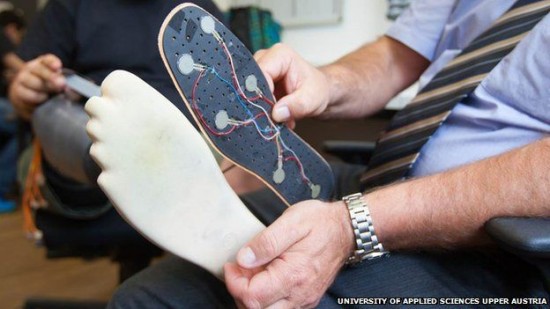
Austrian scientists have invented a revolutionary product in the world of prosthetics – an artificial leg with lifelike sensations. The one-of-a-kind man-made limb has sensors fitted to the sole, which are able to stimulate nerves at the base of the amputee’s stump.
“It feels like I have a foot again,” said Wolfang Rangger, the very first recipient of the sensory-enhanced prosthesis. “I no longer slip on ice and I can tell whether I walk on gravel, concrete, sand, or grass. I can even feel small stones.”
To create the special limb, surgeons first rewired nerve endings on Rangger’s stump, placing them closer to the skin’s surface. Scientists then placed six sensors on the base of the artificial foot, to measure the pressure of heel, toe and foot movement.
The signals picked up by the sensors are transmitted to a micro-controller that relays them to stimulators inside the leg’s shaft. When the stimulator’s vibrate, they activate the nerve endings under the skin of the stump, relaying signals to the brain.
“The sensors tell the brain there is a foot and the wearer has the impression that it rolls off the ground when he walks,” explained Professor Hubert Egger, of the University of Linz. He added that the device gives the brain real data, so it doesn’t have to search for information from a missing limb.
Rangger, 54, lost his right leg in 2007 due to a blood clot caused by a stroke. He has been testing his new leg – both in the lab and at home – for the past six months. One of the major benefits he has experienced is a significant reduction in ‘phantom limb’ pain – an excruciating pain he has suffered for years. He is also able to participate in physical activities like cycling and climbing.
The invention was recently unveiled at a press conference in Vienna, but the research team is yet to publish details in a medical journal. Dr. Alastair Ritchie, of the University of Nottingham, said the announcement, although exciting, isn’t groundbreaking. An international team of researchers already created a bionic hand last year, allowing amputees lifelike sensations through the fingers.
Fuente: www.odditycentral.com