Poor battery life is the number one complaint when it comes to smartphones and laptops. As a wireless society, having to tether ourselves down to power up our gadgets seems more and more a nuisance. And while researchers are looking into wireless charging, if batteries were better we would have to worry less.
Now, a new technology promises just that. Researchers from the University of California, Irvine, have invented a nanowire-based battery that can be recharged hundreds of thousands of times, a significant leap towards a battery that doesn’t require replacing.
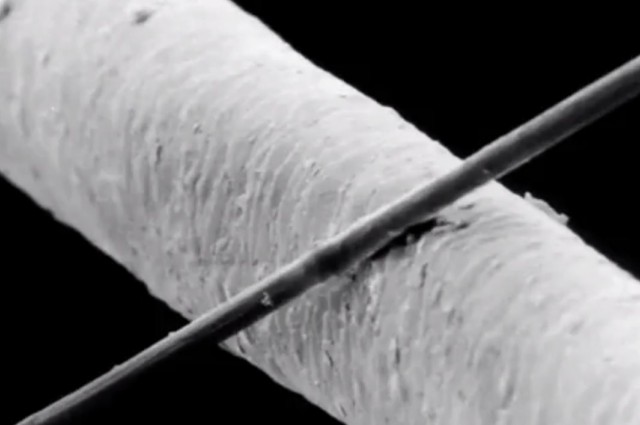
Nanowires possess several ideal characteristics for electric storage and transmission. They are highly conductive and thousands of times thinner than a human hair, which means they can be arranged to provide a large surface area for electron transfer. Unfortunately, nanowires are usually very fragile and don’t do well after repeated charging and discharging.
The researchers, whose findings are published in the American Chemical Society’s Energy Letters, have coated gold nanowires in manganese dioxide and cocooned them in a Plexiglas-like gel. This combination keeps all the properties of the nanowires' intact and makes them resistant to fractures.
Mya Le Thai, the lead study author, has charged and discharged the battery up to 200,000 times without breaking the nanowires and without loss of capacity.
“Mya was playing around, and she coated this whole thing with a very thin gel layer and started to cycle it,” said senior author Reginald Penner, chair of UCI’s chemistry department, in a statement. “She discovered that just by using this gel, she could cycle it hundreds of thousands of times without losing any capacity.”
“That was crazy,” he added, “because these things typically die in dramatic fashion after 5,000 or 6,000 or 7,000 cycles at most.”
The researchers believe that the combination of the PMMA (plexiglass-like) gel electrolyte and the magnesium oxide gives flexibility and structure to the nanowires, preventing cracking and thus extending their operational life.
“The coated electrode holds its shape much better, making it a more reliable option,” Thai said. “This research proves that a nanowire-based battery electrode can have a long lifetime and that we can make these kinds of batteries a reality.”
Fuente: esnoticia.co