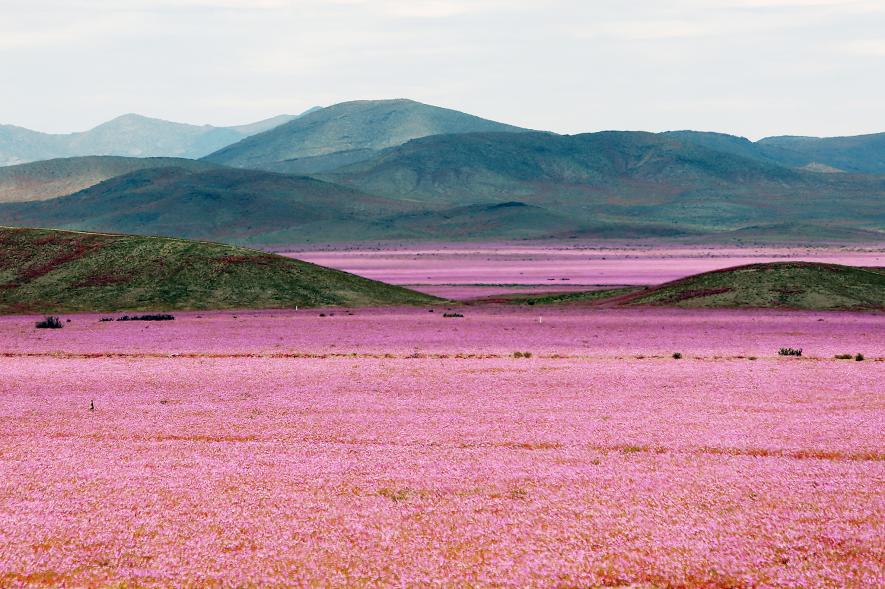
Colorful fields of pink, purple, and white currently coat the sandy soil of north Chile’s Atacama desert, one of the driest regions in the world.
No, it’s not a camera trick or a fancy Instagram filter. The vibrant coat blanketing the normally bare desert ground is made of hundreds of millions of flowers, germinating and flowering in record numbers after bouts of unusual rain.
The phenomenon, called a “desierto florido” (desert in bloom), happens once every five to seven years, according to Pedro León Lobos, a botanist with Chile’s Institute of Agriculture and Livestock Research (IRA). The blooming corresponds with El Niño’s periodic warming of Pacific Ocean waters off the coast of northern Chile.
The warmer waters alter the flow of air across the region, dealing potentially dramatic changes to the area’s rainfall patterns. Normally, the Atacama desert is one of the world’s driest locations, on average getting less than 4 millimeters of rain per year. But unusually strong rains in late March dumped seven years’ worth of rain virtually overnight on the region, causing major floods that killed at least seven people.
The devastating storms kickstarted the germination of millions of seeds of annual plants, some of which bloomed in patches across the Atacama in March. Further storms in August supercharged the flowers’ growth, and more began to bloom in late September — a rare “double bloom” unlike anything in recent memory.
The vibrant floral display also underscores the barren region’s deceptively hidden richness: The extreme conditions disguise nearly 1,900 species of plants and animals, over a third of which can only be found in the Atacama desert. Yet Chilean national parks only offer partial protection of the remote region, despite its biodiversity.
“Only two or three months before these beautiful pictures, [the landscape] looked completely bare,” says Michael Way, a conservationist with the Royal Botanic Gardens, Kew, who traveled to the Atacama in June with the Millennium Seed Bank Partnership. “The contrast really is the evidence that those areas are precious and wonderful.”
Fuente: news.nationalgeographic.com