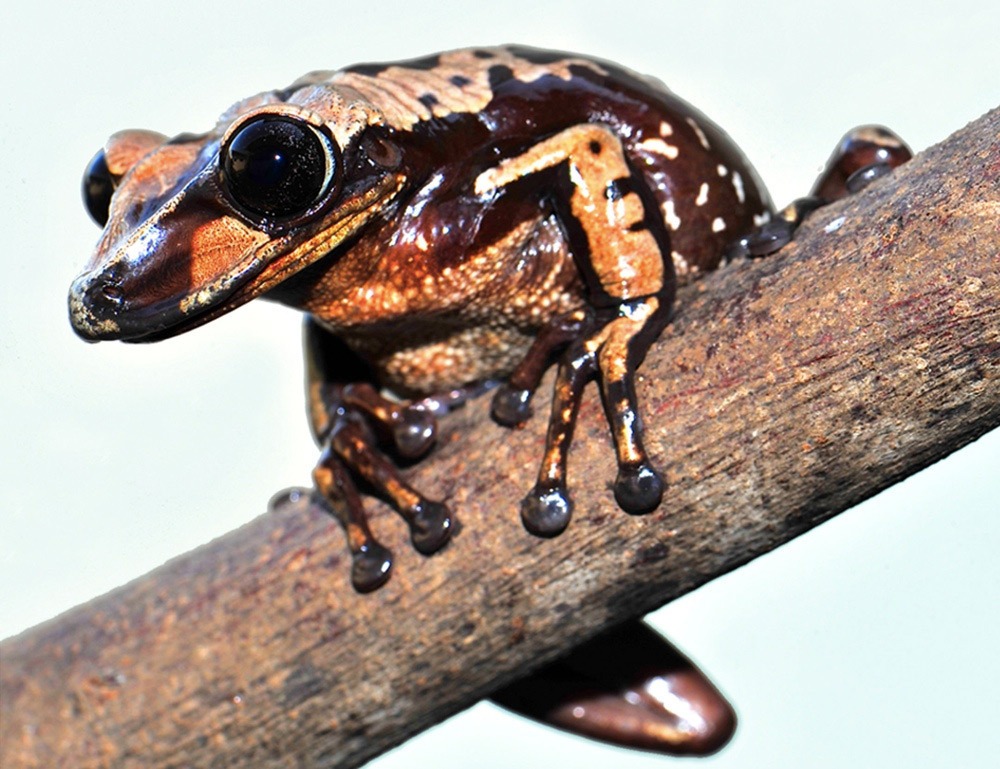
In the wilds of Brazil, researchers have discovered frogs with venomous spikes on their heads.
Although scientists have long known of poisonous frogs, these are the first venomous frogs — that is, they not only secrete poison, but are armed with weapons that can deliver this poison into victims.
Most amphibians, such as frogs, newts and salamanders, concentrate or secrete poisons in skin glands to ward off predators. Frogs include some of the most toxic animals on Earth — for instance, the 2-inch-long (5-centimeter) golden poison dart frog has enough toxin to kill 10 grown men, and the indigenous Emberá people of Colombia have used its poison for centuries in blowgun darts.
Now scientists have discovered — the hard way — two species of Brazilian frog that are venomous. One researcher, study lead author Carlos Jared at the Butantan Institute in São Paulo, injured his hand on bony spines on the head of the frog Corythomantis greeningi, which lives in savannas in eastern Brazil.
The result? "Intense pain, radiating up the arm, lasting for five hours," "Intense pain, radiating up the arm, lasting for five hours," said study co-author Edmund Brodie, Jr., a herpetologist at Utah State University in Logan.
This accident might seem lucky in hindsight, since the species that injured Jared proved to be the less toxic of the two the researchers investigated. "We have not experienced the effect of the venom of the most toxic species, and hope we do not," Brodie told Live Science.
The research team's calculations suggest that a single gram of the venom from the more toxic frog species, Aparasphenodon brunoi, could kill more than 300,000 mice, or about 80 humans, while a gram of the venom from Corythomantis greeningi could kill more than 24,000 mice, or about six humans. In comparison, the venom of the deadly Brazilian Bothrops pit vipers is half as lethal as that of Corythomantis greeningi and 25 times less dangerous as that of Aparasphenodon brunoi.
"The strength of toxicity of the skin secretions is remarkable, and to say we were surprised by that is an understatement," Brodie said. "Amphibians have a wide array of skin toxins that have been well-studied, but this sort of mechanism — transmitting the toxin as a venom — has not been found before. It moves the study of amphibian defenses to a new level."
The frogs are armed with bony spines on their noses, jaws and the backs of their heads. The frogs have unusually flexible necks for frogs, and when grabbed, these amphibians release venom from the skin glands around their spines and flex their heads, jabbing and rubbing their spines into whatever grabbed them. Although Corythomantis greeningi has less toxic venom, it has larger head spines and larger skin glands that secrete more venom than Aparasphenodon brunoi.
When dealing with these frogs, "we now use heavy rubber gloves and handle them as little as possible," Brodie said. "We are careful to avoid getting their skin secretions on our skin because even a small skin abrasion could allow the entry of the venom into the body."
Although scientists have known about these two species of frog for many decades, little was known about their biology. These amphibians have no known predators, which makes perfect sense given these latest findings.
The researchers are not certain whether these frogs are immune to their own venom, but they suspect they are, Brodie said. However, they also think these frogs use their venom only to defend against predators, as opposed to helping them hunt prey, he added.
The researchers are now investigating several other frog species from around the world that they also suspect are venomous. They detailed their findings online August 6 in the journal Current Biology.
Fuente: mashable.com