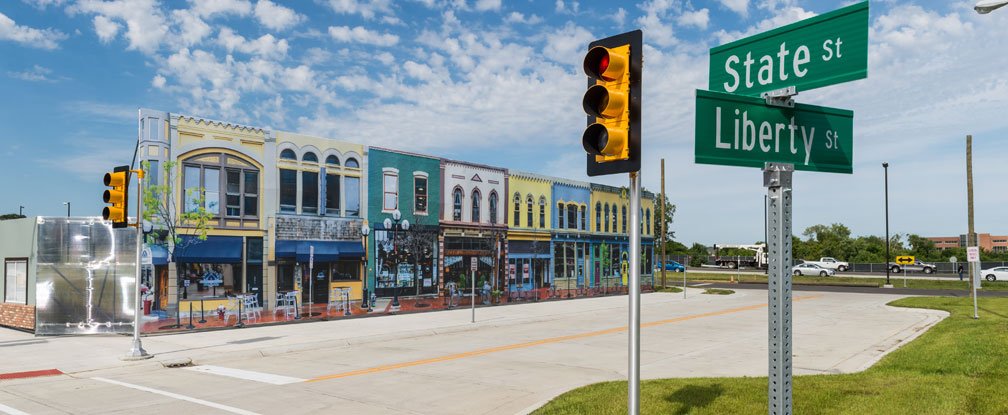
With its two-dimensional building facades looking like something out of a Hollywood Western town, you might expect to see tumbleweed rolling down the main strip. But the only things you’ll find moving through the streets of Mcity are driverless cars, as this artificial town is actually the world’s first controlled environment designed specifically to test self-driving vehicles.
Occupying 13 hectares (32 acres) of land on the University of Michigan’s campus, Mcity will be run by the school’s Mobility Transformation Centre to put all kinds of self-driving cars through their paces. The facility will test networked vehicles that communicate with one another or with a central infrastructure (called V2V or V2I) and also fully autonomous self-driving automobiles.
“There are many challenges ahead as automated vehicles are increasingly deployed on real roadways,” said Peter Sweatman, director of the University’s Mobility Transformation Center, in a release. “Mcity is a safe, controlled, and realistic environment where we are going to figure out how the incredible potential of connected and automated vehicles can be realised quickly, efficiently and safely.”
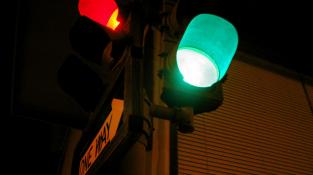
Designed to resemble a regular suburban environment, Mcity’s layout is comprised of a number of connecting roads joined by all the sorts of things you’d expect to find in any small town. The building facades might look paper-thin, but everything else is real: traffic signs, intersections, traffic lights, streetlights and more.
Paved footpaths line the sides of the streets, and Mcity’s designers have gone out of their way to replicate the kinds of impediments that complicate driving for learners, only this time the learners aren’t human. Temporary construction obstacles bar the path of vehicles, plus road signs defaced by graffiti and faded lane markings make it harder for Mcity’s self-driving vehicles to pass their tests with full marks.
According to one of the researchers, Ryan Eustice, the ability to put test vehicles into “maximally evil” driving situations in Mcity at the drop of a hat makes a kilometre of testing in the facility worth hundreds of real-world kilometres, where similarly difficult scenarios are few and far between.
“In terms of the weird stuff, we can pack it all in in a very dense way,” he told Dee-Ann Durbin of Associated Press.
Fuente: www.sciencealert.com