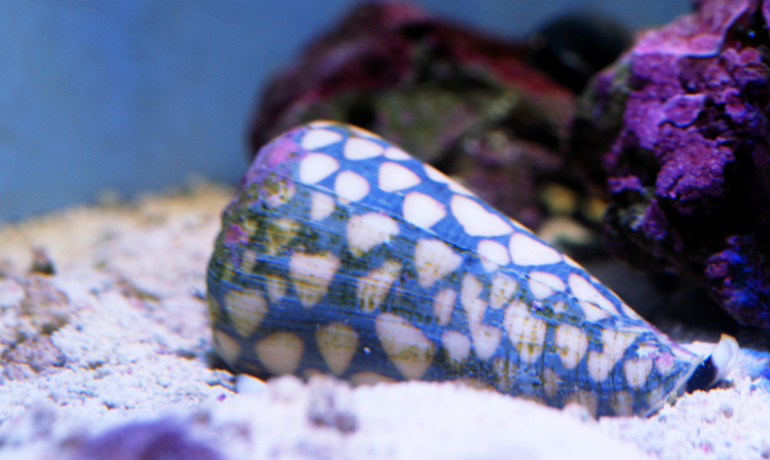
Thousands of peptide toxins hidden deep within the venom of just one type of Queensland cone snail may offer promising new leads for drugs to treat pain and cancer.
In a paper published in the Proceedings of the National Academy of Sciences, researchers describe a new method for analyzing the structure of the venom toxins.
“Cone snail venom is known to contain toxins proven to be valuable drug leads,” says Paul Alewood, a professor at the University of Queensland Institute for Molecular Bioscience.
“This study gives the first-ever snapshot of the toxins that exist in the venom of a single cone snail. Cone snail venoms are a complex cocktail of many chemicals and most of these toxins have been overlooked in the past.”
VENOM OF OTHER SPECIES
Using a new method that involved accurately measuring and analyzing the structure, activity, and composition of the diverse range of proteins within venom, researchers discovered the highest number of peptides (mini-proteins) produced in a single cone snail.
“We also discovered six original ‘frameworks’—3D-shaped molecules suitable as drug leads—which we expect will support drug development in the near future,” Alewood says.
There are 25 known frameworks discovered over the past 25 years, many of which have already led to a drug or drug lead for several diseases.
“We expect these newly discovered frameworks will also lead to new medications, which can be used to treat pain, cancer, and a range of other diseases.”
The cone snail species studied by the researchers, conus episcopatus, is found along the east coast of Australia and is one of 700 different species of cone snails.
“We anticipate there are a lot more interesting molecules to be found in the venom of other species, and we are keen to explore these using our new approach, Alewood says.
“This new method of analysis can also be used in research on other animal venoms, or in related fields, such as studying protein expression from cells. It will help us gain a better understanding of biology, look for disease patterns, or discover potential new drugs.”
Fuente: www.futurity.org