Scientists in Australia have uncovered a galaxy deep in space — 5 billion light-years away from Earth, to be precise.
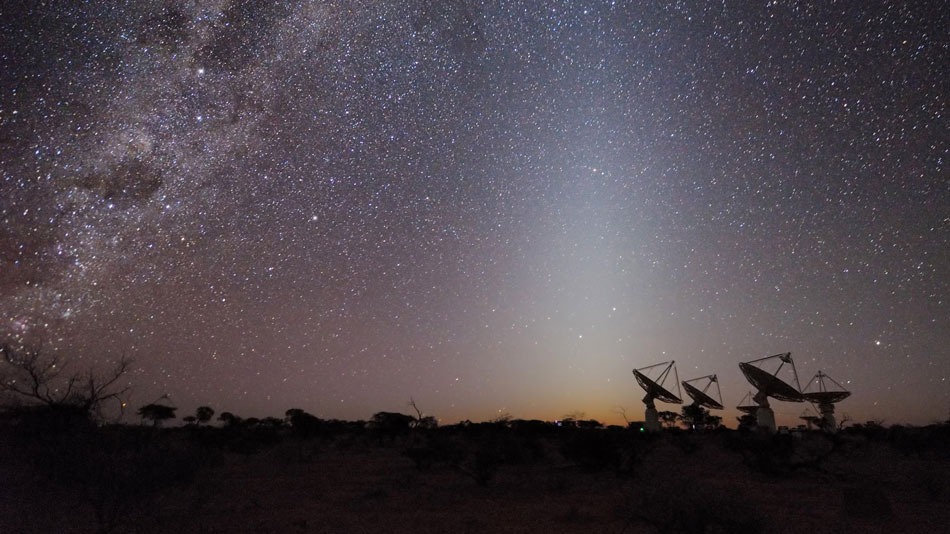
The discovery was made at the Murchison Radio-astronomy Observatory in the Western Australian desert, using the Australian Square Kilometre Array Pathfinder telescope (ASKAP), which is run by Australia's peak science body, the CSIRO.
ASKAP is able to pick up signals from galaxies in the distant universe that are sources of radio waves, Elaine Sadler, a professor of astrophysics at the University of Sydney, told Mashable Australia. The reason these galaxies emit such waves is they have massive black holes at their centre.
"If that radio signal passes through hydrogen gas, it makes a signature at one particular frequency, like tuning into a radio station," she said. "That can tell you the distance the hydrogen has travelled, and that's what this telescope measures."
The newly-discovered galaxy, PKS B1740-517, is in the southern sky near the Ara constellation. The radio waves it has generated have taken 5 billion light-years to reach the Earth. To give you an idea of the distance and time they've covered, when the radio waves started travelling our sun wasn't even born yet.
ASKAP is able to pick up such signals because it's in a really remote area of Australia. Other telescopes around the world haven't been able to make similar measurements because the radio waves can be easily drowned out by other man-made signals here on Earth, like those emitted by mobile towers.
"It's radio quiet out here," Sadler said. "Getting away from the terrestrial noise is what allows us to see these remote galaxies."
ASKAP is also special because it has a very large field of view, like a wide-field camera. Instead of looking at one radio source at a time, scientists can examine one hundred to two hundred, giving them the opportunity to discover these rare objects in numbers people haven't found before.
The best thing is, Sadler and the team have only just started building the telescope. This discovery was made with only the first six satellite dishes online out of an eventual 36.
"We were just making tests of our software, so it was quite a surprise to find something so early," Sadler said. "We hope we will find hundreds or even one thousand of these galaxies. It's just the tip of the iceberg."
Fuente: mashable.com