The International Olympic Committee said Sunday it will order testing for disease-causing viruses in the sewage-polluted waters where athletes will compete during next year's Rio de Janeiro Olympic Games.
Before, the IOC and local Olympic organizers in Rio said they would only test for bacteria in the water, as Brazil and virtually all nations only mandate such testing to determine the safety of recreational waters.
But after an Associated Press investigation published last week revealed high counts of viruses directly linked to human sewage in the Olympic waters, the IOC reversed course after being advised by the World Health Organization (WHO) that it should expand its testing.
"The WHO is saying they are recommending viral testing," IOC medical director Dr. Richard Budgett told the AP. "We've always said we will follow the expert advice, so we will now be asking the appropriate authorities in Rio to follow the expert advice which is for viral testing. We have to follow the best expert advice."
On Saturday, the International Sailing Federation became the first to break with the IOC's insistence on bacteria-only testing, saying it would do its own independent tests for viruses.
"We're going to find someone who can do the testing for us that can safely cover what we need to know from a virus perspective as well as the bacteria perspective," said Peter Sowrey, chief executive of the ISAF. "That's my plan."
That came after the WHO told the AP on Saturday that it had advised the IOC to test for viruses.
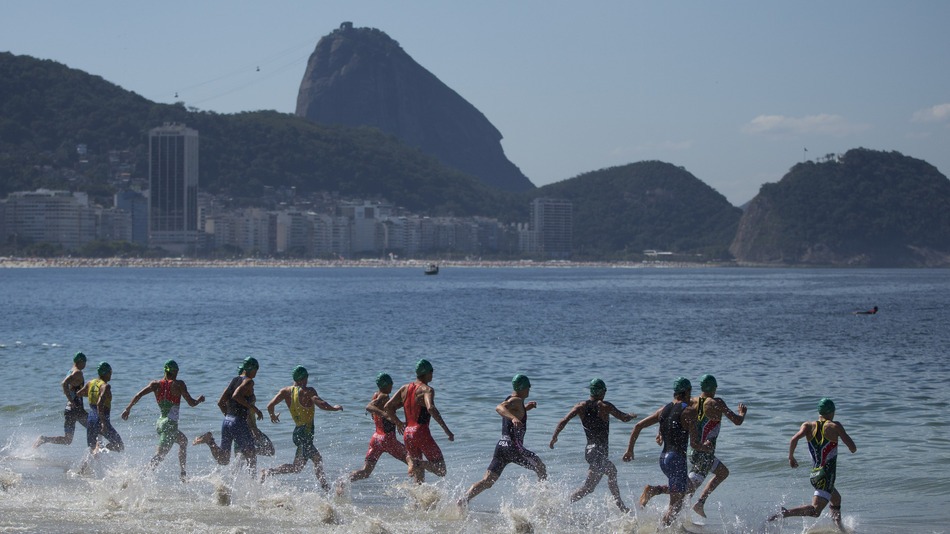
On Sunday, athletes competed under a blazing Rio sun in an Olympic test event in the triathlon.
"It's been an interesting learning experience over the last few days. I think some athletes went back to Biology 101 to learn the difference between bacteria and viruses," said American triathlete Sarah True, who has qualified for next year's Olympics. "It's kind of eye-opening for me that people didn't differentiate the two."
She said that for the athletes, "obviously it's a concern, it's a risk" but that "ultimately the Olympic dream is so strong that sometimes we put the pursuit of excellence above our health."
True said she didn't think the Olympic venue could be moved from Copacabana even if the IOC's tests also find high viral counts.
"We can't move," she said. "Ultimately too much money has been invested."
Others at Sunday's triathlon also expressed little worry about the conditions. Doug Hiller, medical officer for the International Triathlon Union, told Reuters, "If I didn't have to work so hard today, I'd be in the water myself."
So far, neither the IOC nor the sailing federation has said who would do their testing. Virology experts in Brazil say there are only three or four labs with the molecular biology equipment and trained scientists who can carry out the testing for viruses in water.
The AP's tests are being conducted by Fernando Spilki, a respected virologist who is a board member of the Brazilian Society for Virology and editor of its scientific journal. He is not being paid by the AP to conduct the testing, though the AP is purchasing the lab materials required to carry out the research.
When Rio was awarded the games in 2009, it promised that cleaning its waters would be an Olympic legacy. But Rio Mayor Eduardo Paes has repeatedly acknowledged this will not be done, calling it a "lost opportunity."
Fuente: mashable.com