Researchers have determined a method to help amputees be convinced that a prosthetic hand belongs to their own body.
In a scientific collaboration led by the Federal Institute of Technology in Lausanne, Switzerland, they utilized a combination of two senses -- sight and touch -- instead of just "seeing is believing." The results were published Tuesday in the Journal of Neurology, Neurosurgery & Psychiatry.
Prosthetic limbs often don't feel part of patient's bodies, the scientists said. They often still feel their missing limb, which is perceived as bigger than their prosthetic. In addition, they often do not yet have sensory feedback, meaning they must constantly watch it for correct use.
"The brain regularly uses its senses to evaluate what belongs to the body and what is external to the body," Giulio Rognini of the institute's Laboratory of Cognitive Neuroprosthetics said in a press release. "We showed exactly how vision and touch can be combined to trick the amputee's brain into feeling what it sees, inducing embodiment of the prosthetic hand with an additional effect that the phantom limb grows into the prosthetic one."
In 2014, researchers at the institute gave an amputee the ability to feel in real-time with their prosthetic hand. Touch coming from sensors at the fingertips were processed and relayed into the nervous system via electrodes surgically wired to the stump's main nerves.
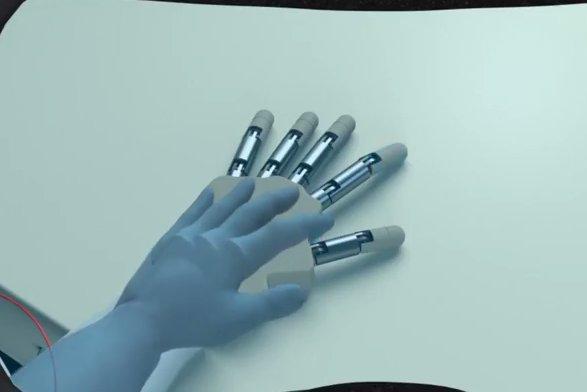
In the new study, scientists provided two hand amputees artificial tactile sensations at the tip of the index finger -- of the phantom limb -- by stimulating the patient's nerve in the stump. In addition, the patient wore virtual reality goggles, which showed the index finger glowing with the administered touch sensations.
In both cases, patients reported feeling as though the prosthetic hand belonged to their body.
They even reported feeling as though their phantom limb had extended into the prosthetic limb.
The phantom limb remained extended for up to 10 minutes afterward.
For the method to work, the visual glow and the artificial touch must occur simultaneously, researchers said.
"The setup is portable and could one day be turned into a therapy to help patients embody their prosthetic limb permanently," Rognini said.