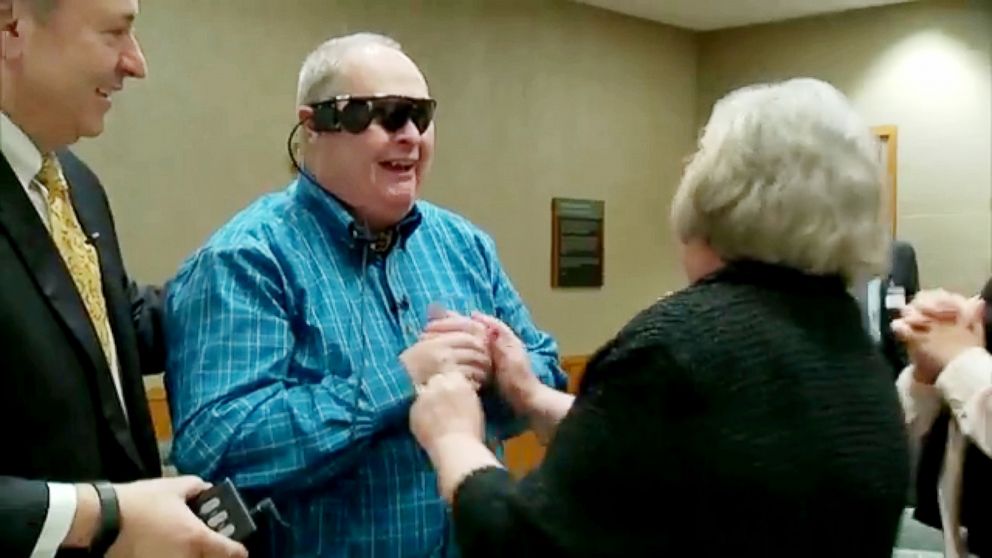
Allen Zderad’s journey into blindness was long and slow. He has a severe form of retinitis pigmentosa, which steadily destroys the retina. For more than a decade he has been effectively blind, unable to see the face of his wife Carmen.
Zderad (prounounced Zayr-ad) is one of a handful of blind people in the country who agreed to try a new bionic retina that is surgically implanted inside the eye. After the surgery at the Mayo Clinic, he stood facing his wife as she walked between him and a white board. “Yes!” he shouted, “I picked you up!” As the scientists applauded, Allen and Carmen embraced each other in tears.
What Zderad sees now is nothing like what he saw before he lost his vision. The image created by the bionic retina is just 60 dots, like pixels on a TV screen or bulbs on a stadium sign. But it’s enough for him to identify shapes and edges, and to see movement. With time and with therapy, Zderad’s brain will get better at interpreting the signals from the bionic retina and translating them into vision.
The device, which was created by Second Sight, Inc., consists of three parts. The patient wears a pair of glasses with a camera in the bridge. The image from the camera is sent through a cord to a small computer that can be carried in a pocket. The computer converts the image into electronic signals, which are then sent wirelessly to the third part of the device — the bionic retina implanted inside the eye.
“It’s an array of electrodes that actually have to lay on a curved surface in the back of the eye, where the retina is,” explains Mayo Clinic eye surgeon Raymond Iezzi, MD. Those signals then travel along the optic nerve, just like the signals from a healthy retina, to the visual cortex in the brain.
Dr. Iezzi foresees a bright future for other patients who have lost their sight, not just to disease but to injury. “I would like to see this technology extended to patients who have lost their eyes,” he says. “We have soldiers who have had terrible trauma and have lost their sight. We have diabetic patients who have lost both of their eyes due to their advanced disease, or patients with advanced glaucoma.”
To help those patients the bionic retina would have to bypass the eye altogether, and send a signal directly to the brain. “I think we’re going to see that happen in our lifetime,” Dr. Iezzi says.
Fuente: www.everydayhealth.com