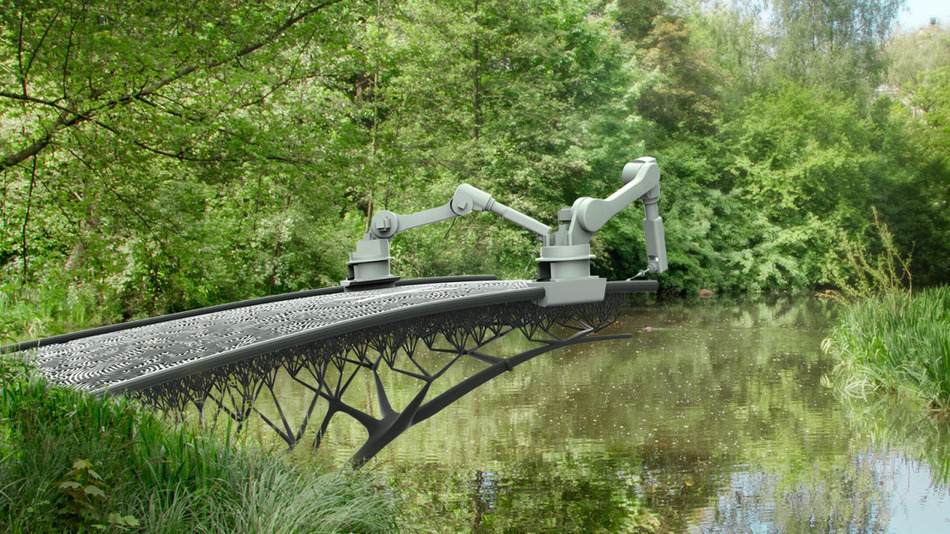
While 3D printing has endless possibilities, we have yet to see many applications in everyday use. That might change, however, with the creation of a 3D-printed steel bridge in Amsterdam.
The city is working with Dutch robot company MX3D and engineering software company Autodesk to create a 3D-printed bridge over a canal there, though an exact location has not yet been released.
MX3D, which is known for 3D printing complex metal shapes in midair without any support structures, is taking on the bridge as its next project.
The bridge is slated for completion in 2017, but will reportedly only take two months to print. According to Fast Company, the bridge will be about 24 feet in length.
MX3D claims its 3D printing technology is more affordable and scalable than others, thanks to robots that can move in six directions (six-axis robots) and print with a variety of strong materials.
MX3D added that building a bridge would be the "ideal way to showcase the endless possibilities of this technique." Another bonus? It could potentially make building bridges safer, faster and cheaper.
If the project is successful, the U.S. government and local municipalities could take notice. Bridges in the U.S. are, by most measures, in pretty bad shape. A 2013 report graded U.S. bridge as a C+, stating that one in nine bridges are "structurally deficient." Fixing all those bridges would, the Federal Highway Administration predicted, cost tens of billions of dollars.
Perhaps one day, 3D printing could bridge that cost and effort gap.